'/%3e%3cpath%20d='M84%20126C60.804%20126%2042%20107.196%2042%2084C42%2060.804%2060.8041%2042%2084%2042L84%20126Z'%20fill='%235546FA'/%3e%3c/svg%3e)
Social Commerce in China

In China, the distance between “I saw it” and “I bought it” can be just a few seconds — and the entire journey may happen inside a social app. Any effective social commerce China strategy starts from that reality: content is no longer simply at the top of the funnel. Increasingly, content is the funnel.
Platforms such as WeChat, Douyin, and Xiaohongshu (RED) have brought discovery, social proof, livestreaming, shopping, payment, and customer engagement into connected ecosystems. For international brands, understanding these connections is becoming an essential part of China ecosystem marketing 2026.
The scale is significant. NIQ's 2026 research values China's social-commerce market at around US$500 billion and projects it could reach US$1.8 trillion by 2030. China's live-commerce market alone reached approximately US$900 billion in 2025, while 59% of consumers across Asia Pacific say they purchase through social platforms.
For international brands, the question is no longer simply, "Which Chinese social platform should we advertise on?" A better question is: How should content, commerce and customer relationships work together across China's digital ecosystem?
What Is a Social Commerce China Strategy?
A social commerce China strategy is a coordinated approach that connects social content, product discovery, recommendations, in-platform commerce and customer retention across platforms such as WeChat, Douyin and Xiaohongshu (RED).
Unlike a traditional social-media funnel that pushes consumers toward an external website, much of the Chinese customer journey can happen within platform ecosystems.
For example:
Douyin discovery → RED research → in-platform purchase → WeChat membership and CRM → repeat purchase
The journey won't always happen in this order. A consumer might discover the brand on RED and buy on Douyin, or encounter a product offline and scan a QR code to enter WeChat.
The important point is that each platform should have a purpose rather than operating as an isolated social account.
What Makes China’s Social Commerce Model Different
Social commerce is the buying and selling of products through social platforms, where discovery, research, recommendation, and purchasing increasingly happen within the same digital ecosystem.
China's execution of this model is what makes it structurally different from conventional “shoppable posts.”
Three characteristics stand out.
1. Super-app infrastructure.
WeChat is much more than a messaging app with shopping features. It combines messaging, Official Accounts, Video Accounts (Channels), Mini Programs, Mini Shops, WeChat Pay, customer service, and social sharing within one ecosystem.
A user can read a brand article, watch a livestream, enter a Mini Program, contact customer service, make a payment, and later return through membership communications without downloading another app.
This significantly reduces friction between content and commerce.
2. Algorithmic “interest commerce.”
Douyin does not rely solely on consumers searching for products.
Its recommendation system distributes short-form videos, livestreams, and product content according to users' interests and behaviour. In other words, products can find consumers before consumers actively search for them.
This inverted discovery model means content quality, product demonstrations, creator fit, and engagement signals can matter as much as traditional keyword-driven product discovery.
3. Trust is social.
Peer reviews on RED, KOL (Key Opinion Leader) and KOC (Key Opinion Consumer) recommendations, livestream demonstrations, user comments, and community discussions put social proof close to the point of purchase.
Consumers can watch someone use a product, read other users' experiences, ask questions during a livestream, compare alternatives, and then purchase.
The practical implication is important: brands cannot simply port a Shopify-plus-Instagram playbook to China.
Winning requires building native experiences where Chinese consumers already discover, evaluate, and purchase products.
WeChat Mini-Programs Explained
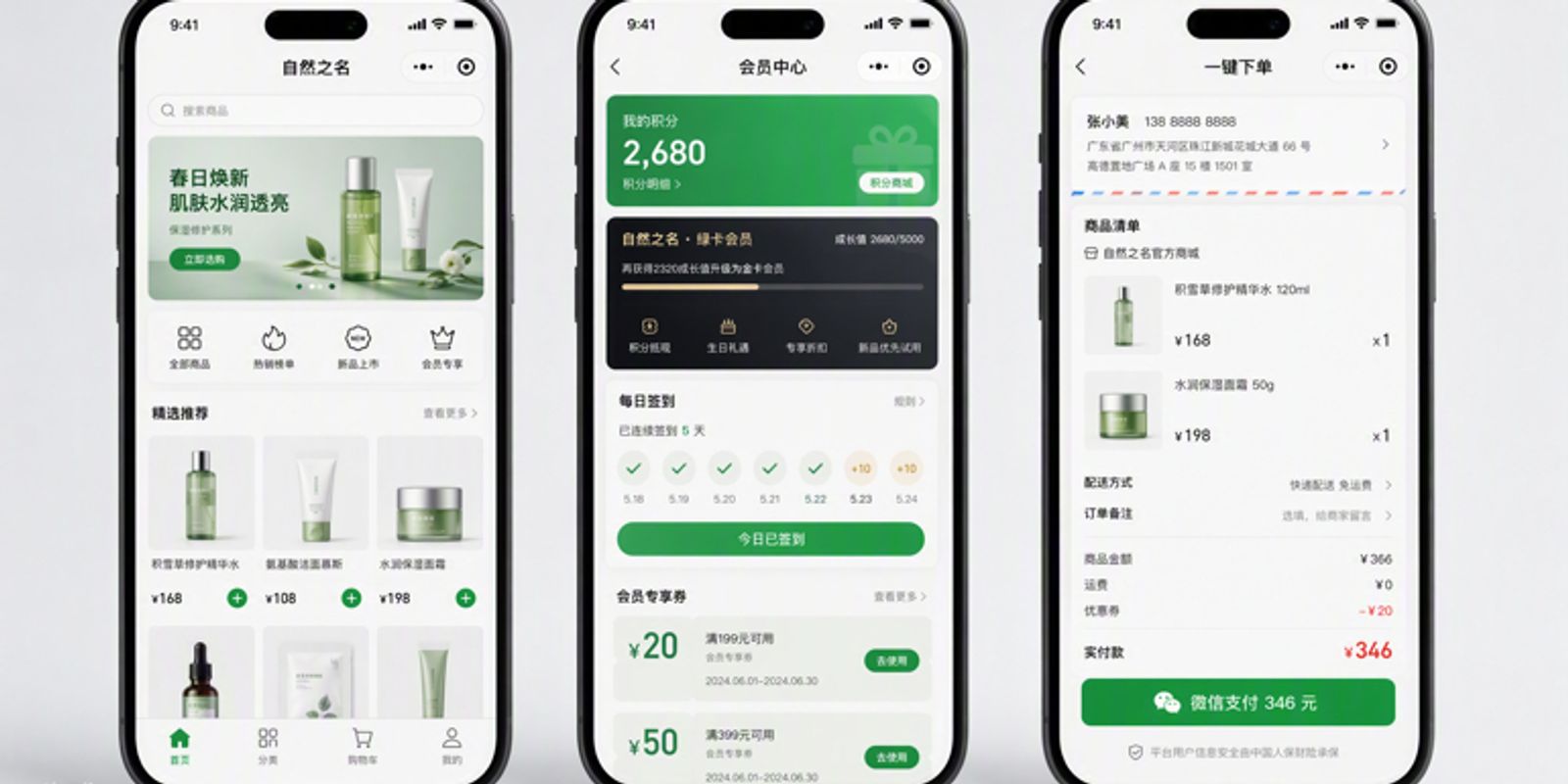
A WeChat Mini Program is a lightweight application that runs directly inside Weixin/WeChat without requiring users to download a separate app. Brands can use Mini Programs for shopping, membership, loyalty, bookings, customer service and other digital experiences.
Their scale makes them especially important for brands thinking about social commerce. Tencent reports that Weixin Mini Programs facilitated RMB 8 trillion in GMV in 2024, with further growth recorded in 2025.
Customers can access a Mini Program through different WeChat touchpoints rather than installing another application. For a retailer, it can become an online storefront. For another company, it might function primarily as a membership hub or service platform.
Mini-Program vs Standalone App
Do international brands need their own app in China? For many brands, a WeChat Mini Program can provide the core commerce and customer functions they need without asking consumers to install another standalone application.
WeChat Mini Program
Standalone App
Access
Opens within WeChat
Requires download
User friction
Lower
Higher
Payments
Weixin Pay integration
Separate integration required
Discovery
WeChat ecosystem, QR codes, sharing
App stores and external promotion
Social connection
Integrated with WeChat ecosystem
More independent
Best suited for
Commerce, loyalty, CRM, services
Complex dedicated experiences
Standalone apps still make sense for companies requiring more complex functionality or those with enough loyal customers to justify a dedicated app.
But for many consumer brands, the simpler journey is attractive:
Discover → Browse → Buy → Join → Return
Integrating CRM, Loyalty, and Payments
A mini-program without back-end integration is just a pretty catalogue. The brands that extract real value wire three systems together from day one:
- CRM (Social CRM): Every mini-program login binds to a WeChat ID. Pipe behavioural data — browsed SKUs, livestream attendance, coupon redemptions — into a China-hosted CRM (e.g., WeCom-integrated or local SCRM providers) to build segments like “livestream viewer, no purchase in 30 days.” Note: China’s PIPL data law means data residency and consent architecture need local legal review — this is not optional.
- Loyalty: Points, membership tiers, and gamified mechanics (sign-in streaks, scratch cards, group-unlock discounts) run natively. Members should earn from social actions — sharing a product card, joining a group buy, writing a review — not just purchases. That’s the flywheel that turns buyers into distribution.
- Payments: WeChat Pay is the default expectation; support split-payment for group buys and one-tap repurchase for replenishment categories. Frictionless payment inside the content moment is the entire point.
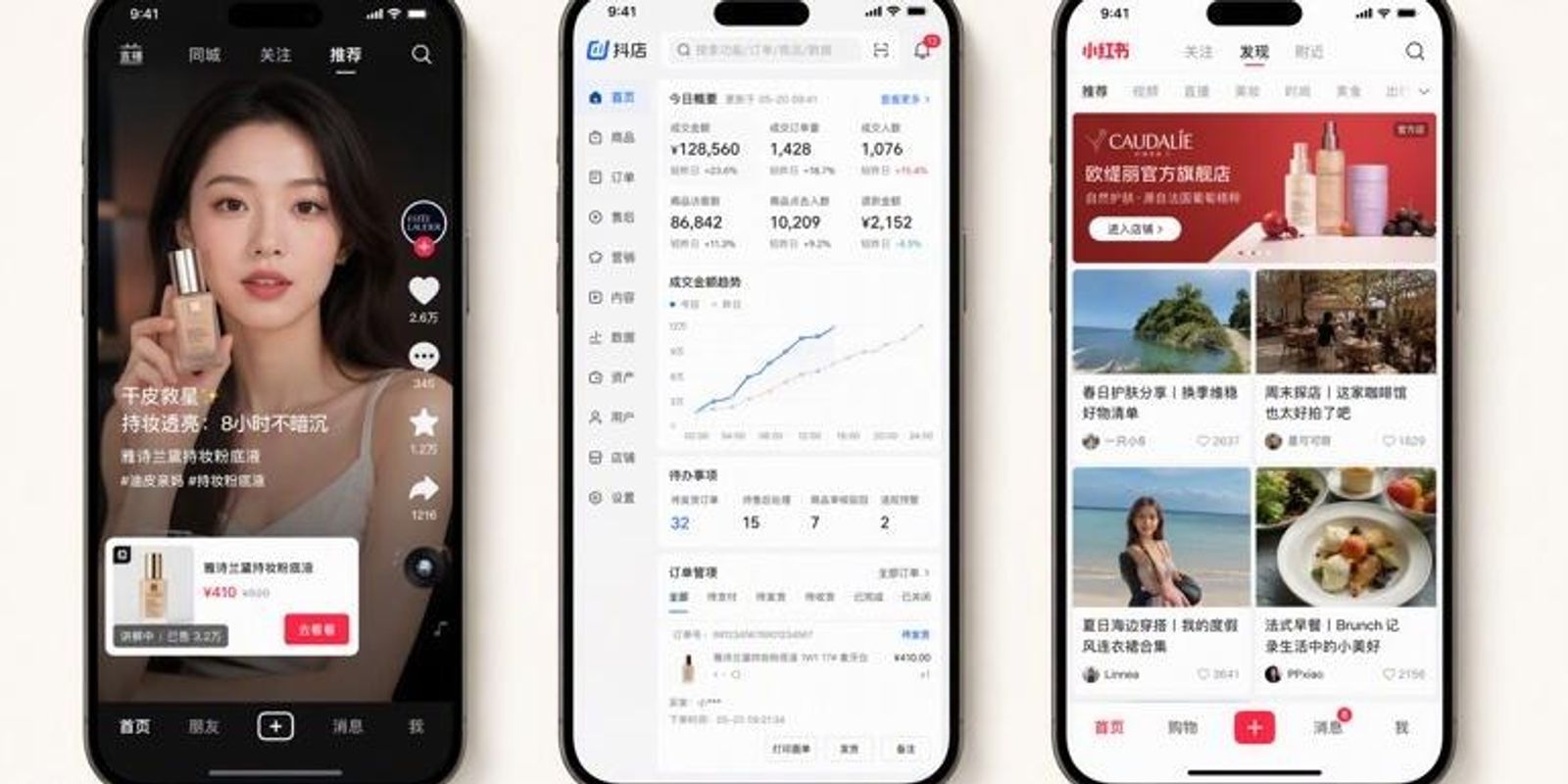
Douyin and RED both connect content with commerce, but consumers use them differently. Douyin is particularly strong for algorithmic discovery, short video and livestreaming, while RED plays an important role in product research, recommendations and social proof.
Douyin: When Content Becomes Commerce
A Douyin shop setup puts products close to the content generating demand for them.
A consumer might be watching videos without intending to shop. A compelling demonstration catches their attention, they explore the product, and the route to purchase is already available.
Livestreaming has become a particularly important part of this model. China's 2025 Livestream E-commerce Industry Development White Paper, reported by the State Administration for Market Regulation, estimates that livestream e-commerce generated more than RMB 5 trillion in GMV in 2025, with around 660 million users.
Official statistics also show that livestream transactions grew 11.3% year on year in 2025.
For brands, opening a Douyin Shop is therefore only the beginning. The store needs content around it: short videos, product demonstrations, creator collaborations, livestreams and, when appropriate, paid amplification.
Without that content engine, the shop is simply another catalogue.RED: The Research and Trust Layer
RED works differently.
Consumers often open Xiaohongshu because they want to know what other people think. Is this product worth the money? How does it look in real life? What are the alternatives? Does it actually work as advertised?
This makes RED particularly useful during the consideration stage.
KOLs can generate reach, while smaller KOCs and ordinary consumers can create relatable product experiences. Reviews, tutorials, comparisons, lifestyle content and user-generated posts can continue influencing search and consideration beyond the original campaign period.
So while Douyin can introduce a product to someone who wasn't looking for it, RED can help answer the questions they ask before deciding whether to buy it.
A successful China social-commerce funnel connects discovery, consideration, purchase and retention rather than managing each platform separately.
Imagine a beauty brand entering China.
A customer first sees a 15-second Douyin video demonstrating the product. She doesn't buy immediately. Later, she searches the brand on RED and reads several reviews. After seeing more content, she purchases during a livestream. She then joins the brand's WeChat membership program and receives a loyalty benefit for her next purchase.
That journey can be broken into five connected stages.
Discovery: Douyin videos, RED posts, KOL/KOC content and livestreams introduce the brand.
Consideration: Reviews, comparisons, demonstrations and social conversations answer questions and build confidence.
Conversion: Douyin Shops, livestream commerce, Mini Programs and other e-commerce touchpoints make purchasing straightforward.
Retention: WeChat, membership programs, CRM, customer service and loyalty benefits give customers reasons to return.
Advocacy: Reviews and user-generated content from existing customers provide social proof for the next group of consumers.
This last stage is important. In social commerce, today's customer can become part of tomorrow's marketing.
Content → Discovery → Trust → Purchase → Membership → Advocacy → New Discovery
Measuring ROI Across the Social Commerce Ecosystem
Cross-platform measurement is the hardest part of China ecosystem marketing 2026 planning, because each platform guards its data. A workable measurement stack:
- Platform metrics: Track GMV, conversion rate, AOV, engagement, refund rate, livestream performance, store performance, and follower-to-customer conversion where relevant.
For livestream commerce, GPM — GMV generated per thousand impressions — can also help evaluate traffic efficiency.
- Unified attribution: Tag entry points wherever technically possible. QR codes can be assigned to different stores or campaigns, while creator links, coupon codes, and campaign identifiers can help distinguish acquisition sources.
These signals can then feed into an SCRM or analytics system where technically and legally appropriate.
- Cohort-level economics: Compare the 90-day or longer-term value of customers acquired through different channels.
A customer acquired through a KOL livestream may behave differently from someone acquired through a brand livestream, RED search, or organic Douyin video.
The cheapest acquisition channel is therefore not necessarily the most profitable one.
A practical ROI formula is:
- Social Commerce ROI = (Attributed Revenue × Gross Margin − Platform Fees − Creator/Agency Costs − Content Production Costs) ÷ Total Marketing Investment
Impressions, views, likes, and follower growth remain useful indicators, but they should support — rather than replace — revenue, margin, customer acquisition cost, repeat purchase, and customer lifetime value.
Brands entering China should also set realistic expectations. The first few months are often a period of testing creative, creators, products, audiences, and platform mechanics rather than an immediate ROI-maximisation window.
Getting Started: A Phased Rollout Plan
Brands entering China's social-commerce market do not need to launch WeChat, Douyin, RED, livestreaming and a large KOL program simultaneously. A phased rollout makes it easier to test demand before committing larger budgets.
Start with the foundation. Understand the target consumer, localize the brand positioning, determine whether domestic or cross-border commerce is more appropriate, and choose the platforms that genuinely matter for the category.
Next, test content. Experiment with RED posts, Douyin videos, creators, products and messages. Look at what people save, search for, discuss and eventually buy.
Once those signals become clearer, build the commerce layer. That might involve completing a Douyin shop setup, developing a WeChat Mini Program for brands, or strengthening an existing marketplace presence.
Then focus on retention. Connect customers to membership, CRM, loyalty and customer service so the business isn't paying to acquire the same customer repeatedly.
Finally, scale the formats and channels that demonstrate commercial value.
This matters in a market where e-commerce remains enormous. China's online retail sales reached RMB 15.97 trillion in 2025, up 8.6% year on year, while physical-goods online retail reached RMB 13.09 trillion.
A phased approach may look slower on a presentation slide, but it gives brands something more valuable: evidence about what Chinese consumers actually respond to before the largest budgets are committed.
Frequently Asked Questions
What is social commerce in China?
Social commerce in China combines social content, recommendations, product discovery and e-commerce within connected digital platforms. Consumers can discover products through WeChat, Douyin or RED, research them through creators and other users, and often purchase within the same platform ecosystem.
What is a social commerce China strategy?
A social commerce China strategy defines how platforms such as WeChat, Douyin and RED work together across discovery, consideration, conversion and retention. Rather than treating each platform as an independent marketing channel, brands assign each one a role in the wider customer journey.
What is a WeChat Mini Program for brands?
A WeChat Mini Program is a lightweight application running within WeChat. Brands can use Mini Programs for e-commerce, membership, loyalty, bookings and customer service without requiring customers to install a separate app. Tencent says Mini Programs facilitated RMB 8 trillion in GMV in 2024.
How do brands set up a Douyin Shop in China?
The exact Douyin shop setup depends on the company's business structure, product category and whether it uses a domestic or cross-border route. Once established, the store can connect products with short videos, livestreaming and other Douyin commerce surfaces.
What is the difference between Douyin and Xiaohongshu for e-commerce?
Douyin is particularly strong for algorithmic product discovery, short-form video, livestreaming and commerce, while Xiaohongshu (RED) is valuable for research, recommendations and social proof. Many brands use the two together rather than treating them as substitutes.
How should brands measure social commerce ROI in China?
Brands should look beyond impressions and followers. Important metrics include GMV, conversion, customer acquisition cost, average order value, refund rate, repeat purchase and customer lifetime value, while recognizing that content on one platform may influence a purchase on another.
Building a Social Commerce China Strategy for 2026
China's social-commerce landscape can look complicated from the outside, but the underlying idea is simple: make it easy for consumers to move from discovering your brand to trusting it, buying from it and coming back.
The platforms are different parts of that journey. Douyin can introduce a product to someone who wasn't looking for it. RED can provide the reviews and recommendations they want before making a decision. WeChat can help turn that first transaction into a longer-term customer relationship.
For international brands, that is a more useful way to approach a social commerce China strategy in 2026 than trying to be everywhere at once. The goal isn't simply to add more Chinese social-media accounts; it is to build an ecosystem in which content generates discovery, social proof builds trust, commerce captures demand, and CRM supports retention.
China Digital Dynamics helps international brands navigate this ecosystem across WeChat, Douyin, RED, KOL/KOC marketing, localized content and social commerce building China digital strategies around how consumers actually discover, evaluate and buy.