'/%3e%3cpath%20d='M84%20126C60.804%20126%2042%20107.196%2042%2084C42%2060.804%2060.8041%2042%2084%2042L84%20126Z'%20fill='%235546FA'/%3e%3c/svg%3e)
Baidu SEO for Foreign Brands_ The Complete 2026 Guide

Baidu SEO for foreign brands requires a China-specific strategy for technical SEO, website accessibility, regulatory compliance, and Chinese-language localization—not simply a translated Google SEO playbook.
China represents a significant organic search opportunity for international companies, but success on Baidu requires more than converting an English website into Simplified Chinese.
Foreign websites can perform well on Google yet struggle on Baidu because of Mainland accessibility issues, slow-loading third-party resources, weak Chinese keyword targeting, limited Baidu indexation, or misunderstandings around ICP requirements.
At China Digital Dynamics, our approach starts with four questions: Can users in Mainland China access the website reliably? Can Baiduspider crawl it? Does the content reflect how Chinese users actually search? And is the website infrastructure appropriate for the market?
This guide explains the key areas international companies should evaluate in 2026, drawing on Baidu's official documentation, Chinese government regulations, and practical China digital marketing principles.
Why Google SEO Tactics Don't Work on Baidu
Baidu has its own crawler, indexing systems, webmaster tools, and Chinese-language search environment, so Google SEO tactics should be adapted rather than copied.
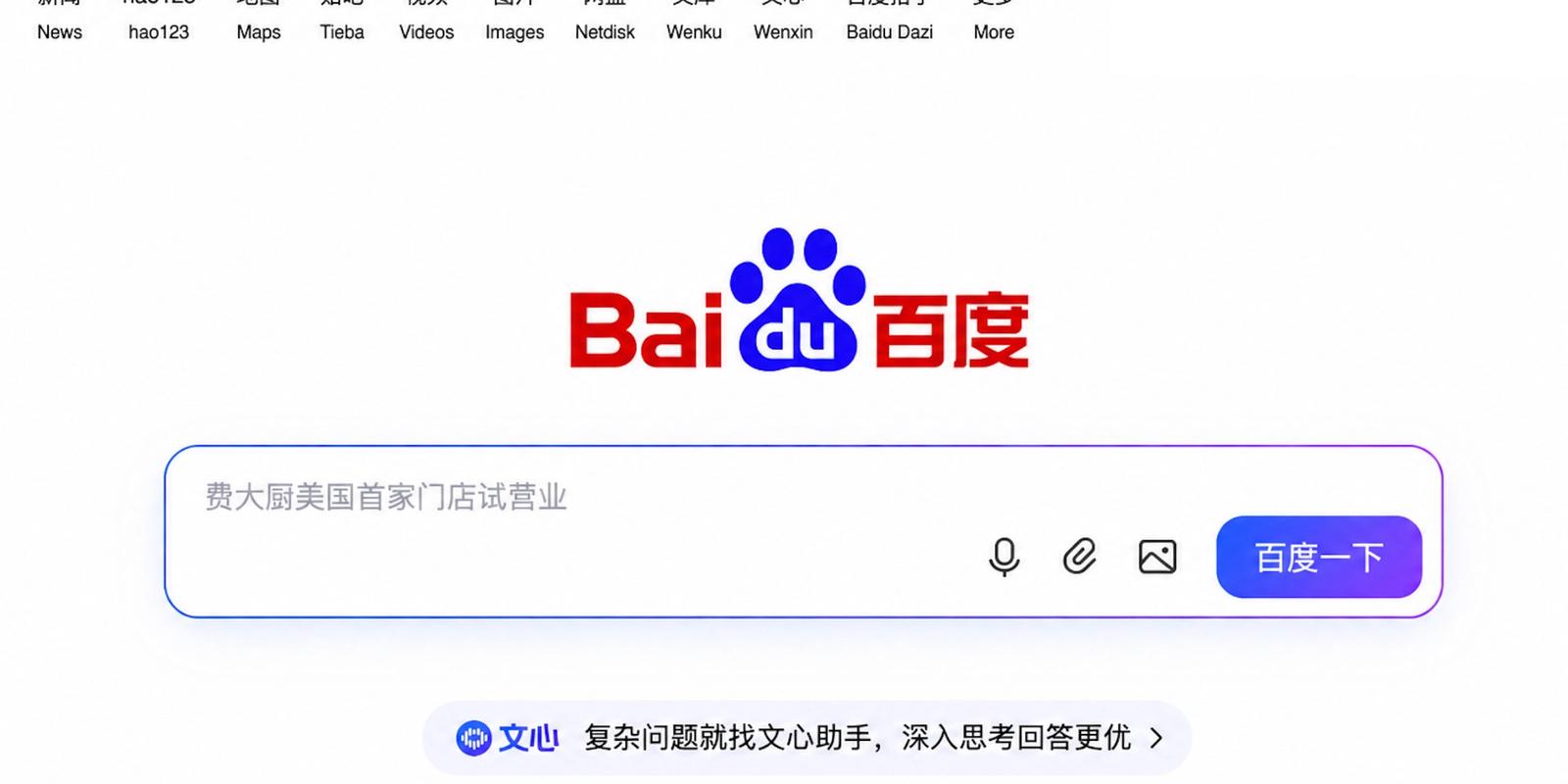
Both Google and Baidu aim to connect users with useful information, but the path to organic visibility differs.
A common international SEO approach is:
Global website → translate into Chinese → change metadata → wait for Baidu traffic.
That is rarely enough.
Baidu operates its own Search Resource Platform, which provides tools for URL submission, index monitoring, crawl diagnostics, robots management, dead-link submission, mobile adaptation, and website migration.
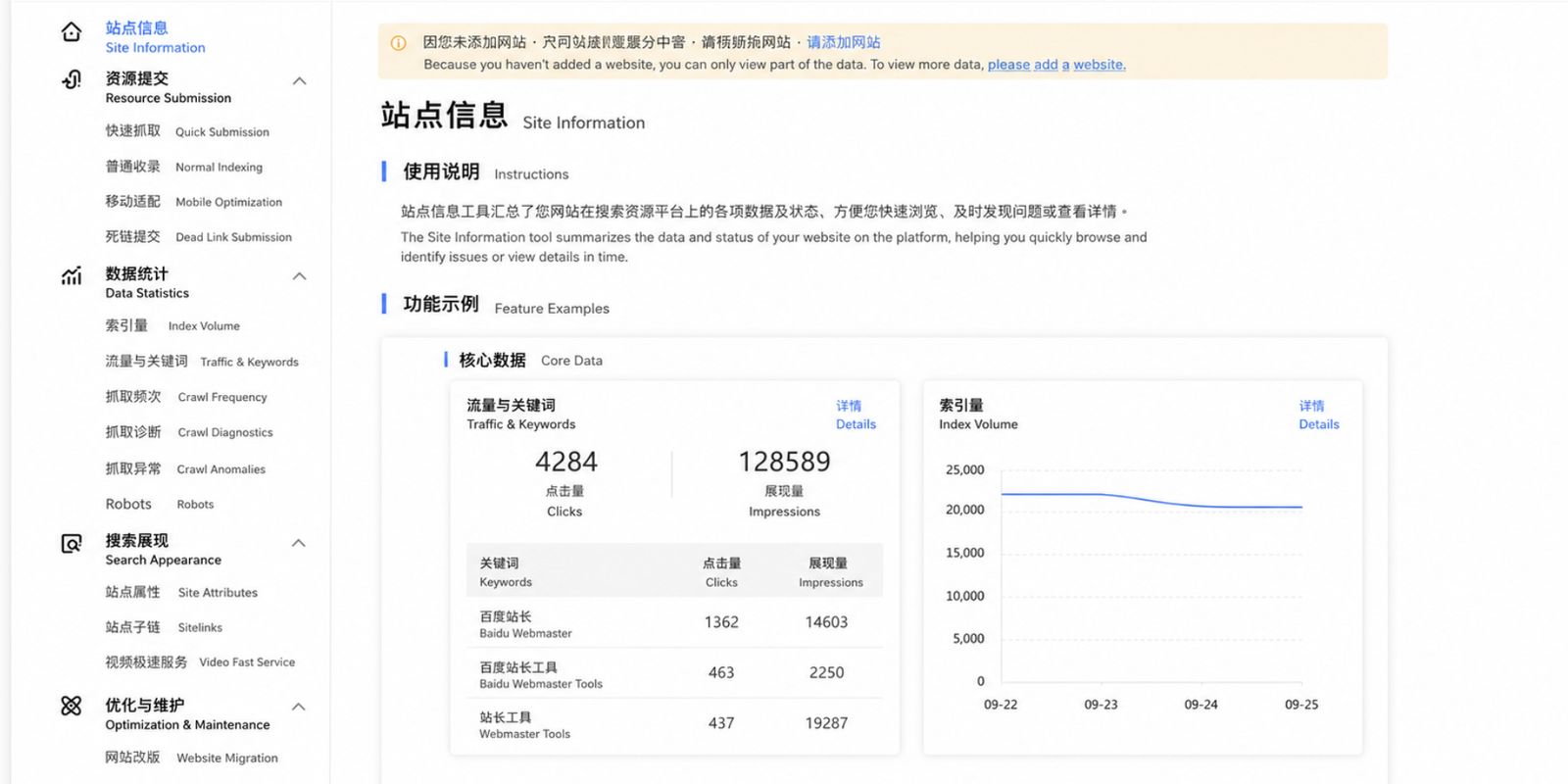
According to Baidu's official documentation, proactive URL submission can help Baiduspider discover newly published pages faster. For companies publishing Chinese articles, landing pages, or product pages regularly, URL submission should therefore become part of the publishing workflow.
Content quality matters too. Baidu's search-quality guidance emphasizes useful content that satisfies user needs, while its webpage title guidelines recommend titles that are accurate, concise, relevant, unique, and free from unnecessary keyword repetition.
Some outdated Baidu SEO advice still promotes aggressive keyword density. A stronger approach is:
Optimize for Chinese search intent first and keyword frequency second.
This creates clearer, more useful content for users while making the page easier for search systems to interpret.
Does Baidu Automatically Find New Pages?
Yes, but proactively submitting important URLs can help Baidu discover new content more efficiently.
Baidu supports API submission, Sitemap submission, and manual URL submission. Frequently updated websites can integrate submission into their publishing process alongside technical SEO monitoring.
E-E-A-T principle: Base recommendations on Baidu's published documentation wherever possible and support technical guidance with original screenshots or first-party audit evidence.
What Is an ICP License and Do You Need One?
Most corporate or informational websites hosted in Mainland China require an ICP filing rather than a commercial ICP license.
The keyword ICP license China website often causes confusion because English-language articles frequently use “ICP license” as a blanket term for China's website registration requirements.
Technically, ICP filing and ICP licensing are different.
China's Measures for the Administration of Internet Information Services divides internet information services into:
- Commercial internet information services — subject to licensing.
- Non-commercial internet information services — subject to filing.
For a typical corporate website providing company, product, service, and contact information, the relevant Mainland-hosting requirement will generally be an ICP filing, not a commercial ICP license.
However, the actual requirement depends on the website's activities, corporate structure, industry, and services offered. Certain regulated sectors may require additional approvals, while foreign-invested businesses may also need to consider China's rules for value-added telecommunications services.
China's Ministry of Industry and Information Technology (MIIT) launched a pilot in 2024 expanding foreign access to certain value-added telecommunications services in designated areas of Beijing, Shanghai, Hainan, and Shenzhen.
Practical takeaway: Determine the website's business activity and applicable filing or licensing route before committing to Mainland hosting.
ICP License vs ICP Filing: Key Differences
ICP filing generally applies to non-commercial internet information services, while qualifying commercial services require licensing.
Requirement
ICP Filing
ICP Commercial License
Chinese term
ICP备案
ICP许可证
System
Filing
Licensing
Generally applies to
Non-commercial internet information services
Commercial internet information services
Typical foreign-brand relevance
Corporate or informational sites using Mainland hosting
Certain commercial internet businesses
Process
Filing / registration
Formal license application
Regulatory timeframe
Up to 20 working days after complete materials are received
Decision within 60 days after application is received
E-E-A-T principle: Use precise terminology and link to official MIIT sources rather than relying only on third-party summaries.
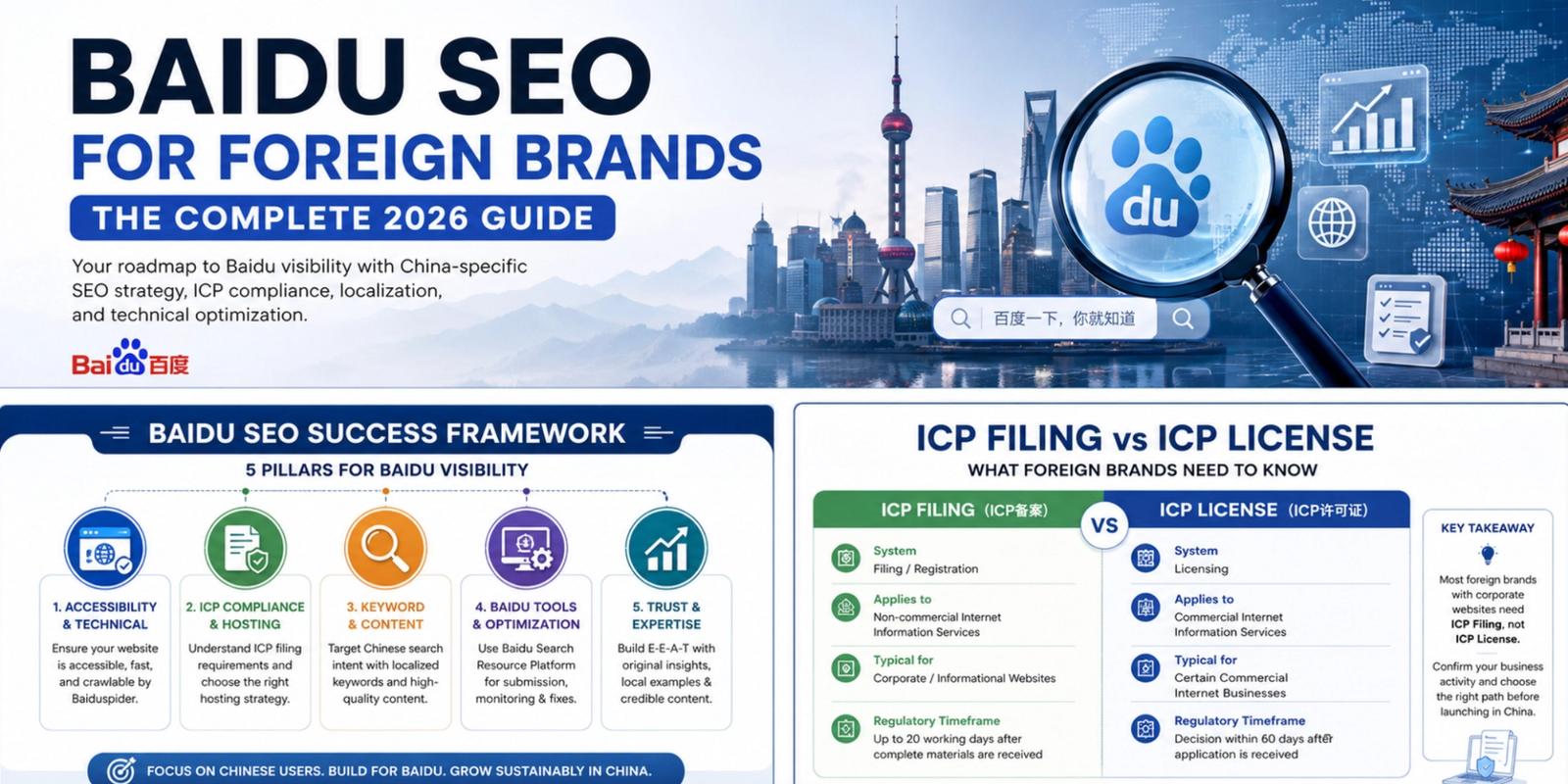
How Long Does ICP Approval Take?
ICP filing has a regulatory timeframe of up to 20 working days after complete materials are received, while commercial licensing follows a longer review process.
China's non-commercial internet information services filing rules state that filing should be completed within 20 working days when materials are complete.
For commercial internet information services, applicable regulations provide for a decision within 60 days after receiving the application.
These are regulatory review periods, not guaranteed end-to-end launch times. The complete process can also involve company verification, domain information, responsible-person details, hosting-provider requirements, and supporting documentation.
Planning recommendation: Treat ICP preparation as an early website workstream rather than a final launch task.
Mainland Hosting vs China-Optimized CDN
Mainland China website hosting is not a published Baidu ranking requirement, but accessibility, speed, reliability, and crawlability in China can materially affect SEO performance.
No published Baidu rule states that a website must be hosted in Mainland China to appear in search results.
Foreign brands should therefore be cautious about claims that “Baidu automatically ranks Mainland-hosted websites higher.”
The stronger reason to consider Mainland infrastructure is performance and user experience.
A website that loads slowly, fails to deliver essential resources, or behaves inconsistently for Chinese users creates problems regardless of search engine.
Mainland hosting may be suitable for companies with the appropriate corporate and regulatory setup, but it introduces applicable ICP requirements.
For businesses that are not ready for Mainland hosting, an alternative may be an offshore architecture optimized for Chinese users. This can involve infrastructure geographically close to Mainland China combined with a China-oriented CDN or acceleration solution.
The key question is not simply “Where is the server?” It is “How well does the website perform for users and crawlers in Mainland China?”
What Should You Test During a Baidu SEO Audit?
Test the website from Mainland China for speed, accessibility, rendering, and Baiduspider crawlability.
Important checks include:
- DNS resolution
- Time to first byte (TTFB)
- Mobile page speed
- JavaScript and CSS loading
- Fonts, images, and video delivery
- Third-party APIs
- Tracking scripts
- Baiduspider accessibility
- Server uptime and stability
E-E-A-T opportunity: Include an original Mainland performance screenshot or audit example to support recommendations with first-party evidence.
Simplified Chinese Content and Localization Requirements
Effective Baidu localization means researching how Chinese customers actually search, not directly translating English keywords and webpages.
Translation asks:
“What does this English sentence mean in Chinese?”
SEO localization asks:
“What would a Chinese customer type into Baidu?”
Those are different questions.
A translation can be linguistically correct but still target the wrong keyword or search intent.
Effective Chinese keyword research should evaluate:
- Chinese product and category terminology
- Industry-specific language
- Commercial-intent searches
- Informational questions
- Competitor terminology
- Chinese abbreviations
- English terminology commonly retained in China
- Chinese transliterations
- Long-tail questions
This research should influence the architecture and content of the Chinese website rather than simply recreating the English navigation.
Can AI Translate Content for Baidu SEO?
AI can accelerate Chinese translation and content creation, but SEO-critical content still requires human review for accuracy, terminology, search intent, and cultural context.
AI is useful for first drafts, keyword clustering, content briefs, and localization at scale. However, a grammatically correct translation does not necessarily reflect how Chinese users actually search.
For Baidu SEO, use AI to improve efficiency—not as a substitute for Chinese keyword research and editorial expertise.
How Does E-E-A-T Apply to Baidu Content?
E-E-A-T is Google's terminology, but Baidu's own quality guidance similarly emphasizes credible publishers, professional content, good user experience, and useful information.
For foreign brands, strong China-focused content should demonstrate expertise through firsthand experience, original screenshots, local examples, case studies, expert commentary, named authors, relevant credentials, and primary-source citations.
Instead of simply saying “Baidu Search Resource Platform helps SEO,” show the relevant screen, explain the data, and demonstrate how it can help diagnose an indexing problem.
This turns a generic statement into evidence-based expertise.
Baidu Webmaster Tools Setup Checklist
Verify your website in Baidu Search Resource Platform and continuously monitor submission, crawling, indexing, and technical issues.
The following Baidu SEO checklist 2026 provides a practical starting point:
- Verify the website in Baidu Search Resource Platform.
- Check robots.txt to ensure Baiduspider is not blocked.
- Submit priority URLs through Baidu's supported tools.
- Configure Sitemap submission where appropriate.
- Consider API submission for frequently updated sites.
- Monitor indexation against submitted pages.
- Review crawler activity for unusual patterns.
- Use crawl diagnostics for inaccessible pages.
- Manage dead links through redirects or removal.
- Check mobile performance and usability.
- Review page titles for accuracy and uniqueness.
- Test from Mainland China, not only overseas.
- Validate Chinese search intent before targeting keywords.
- Monitor continuously rather than treating SEO as a one-time setup.
Technical note: Baidu states that responsive websites do not require its separate mobile-adaptation tool. Websites using separate desktop and mobile URLs can use mobile adaptation to communicate the relationship between those pages.
Common Baidu SEO Mistakes Foreign Brands Make
The biggest Baidu SEO mistake is treating China as a translated version of a global website instead of a distinct digital market.
- Treating Baidu as “Chinese Google” — Use Google SEO knowledge as a foundation, but build a China-specific strategy.
- Translating English keywords directly — Research how Chinese users actually search.
- Confusing ICP filing with ICP licensing — They are not the same and may involve different requirements.
- Assuming Mainland hosting guarantees better rankings — Focus on performance, accessibility, and crawlability.
- Testing website speed only outside China — International performance may not reflect Mainland performance.
- Publishing unreviewed AI-generated or machine-translated content — Use AI for efficiency, but review important content for Chinese language, accuracy, and search intent.
- Keyword stuffing — Baidu's own title guidance discourages unnecessary repetition.
- Ignoring Baidu's submission tools — Actively submit and monitor important pages.
- Ignoring mobile UX — Mobile performance should be a core China SEO priority.
- Publishing generic content without evidence — Original research, screenshots, expert explanations, and real examples improve trust.
How CDD Helps Brands Get Baidu-Ready
CDD helps international brands build a Baidu-ready foundation through Chinese keyword research, localization, technical SEO, accessibility testing, and China-focused website strategy.
Our goal is not simply to get a website indexed. The broader objective is to build sustainable organic visibility among Chinese audiences.
China Website & Baidu Readiness Audit
We assess accessibility, crawlability, mobile performance, technical architecture, and third-party dependencies that may affect Mainland users.
Chinese Keyword Research
We identify how Chinese audiences search rather than simply translating an existing Google keyword list.
Simplified Chinese Localization
We adapt global content around Chinese terminology, user expectations, search intent, and brand positioning.
Technical Baidu SEO
Our framework can include metadata, URLs, internal linking, robots directives, indexation, crawlability, mobile implementation, Sitemap configuration, and Baidu resource submission.
Hosting & ICP Readiness
We help brands identify the infrastructure and regulatory questions to consider when evaluating Mainland China website hosting versus a China-optimized offshore setup.
CDD provides marketing and digital strategy guidance, not legal advice. Where formal regulatory interpretation is required, businesses should consult qualified legal or compliance professionals.
Baidu Search Resource Platform
We help brands understand the tools used to submit, monitor, and diagnose their website's presence in Baidu search.
China SEO Content Strategy
Once the technical foundation is established, the next stage is creating localized landing pages, articles, FAQs, and search-driven content based on real Chinese search behavior.
Is Your Website Ready for Baidu?
A Baidu-ready website should be accessible from Mainland China, crawlable by Baiduspider, localized around Chinese search behavior, technically optimized, and supported by appropriate regulatory planning.
Before investing heavily in content or backlinks, ask five questions:
- Can users in Mainland China access the website reliably?
- Can Baiduspider crawl the important pages?
- Does the infrastructure require ICP filing or licensing?
- Does the Chinese content reflect real local search behavior?
- Does the website demonstrate genuine expertise and trust?
If any answer is unclear, fix the foundation first.
China should be treated as its own digital market—not simply another language folder on a global website.
For Baidu SEO for foreign brands, the strongest strategy combines technical accessibility, Chinese keyword research, localized content, Baidu-specific optimization, regulatory awareness, and demonstrable expertise.
Get those fundamentals right first, and every subsequent investment in Chinese organic search has a stronger foundation.